
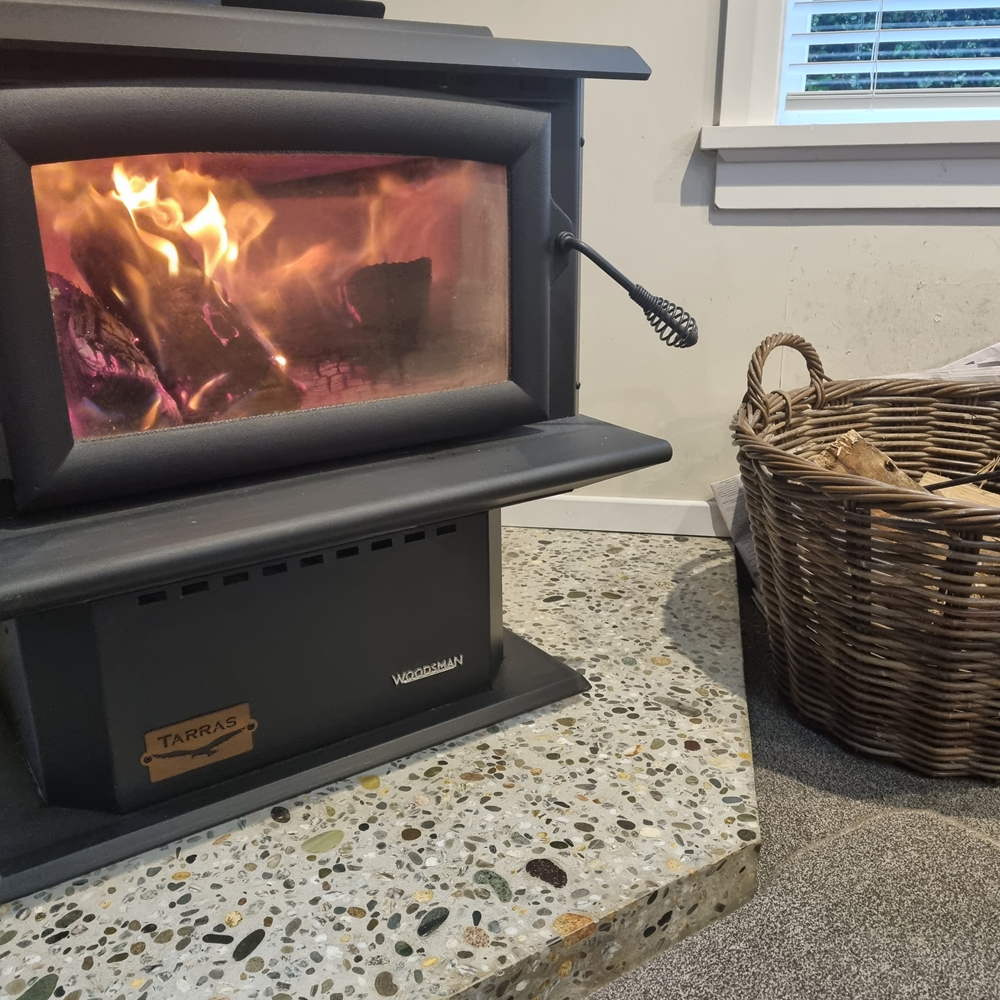
When people think about fireplaces, they usually focus on the fire itself. The flames, the warmth, the atmosphere. But the hearth, the surface it all sits on, plays a much bigger role than most expect. It quietly shapes how the whole space feels and often becomes a defining feature once everything is in place.
A well-designed fire hearth does more than meet safety requirements. It anchors the fireplace visually and creates a clear connection between the fire and the rest of the room. With polished concrete, that foundation becomes something more refined and intentional. Instead of a flat, purely functional surface, you get depth, texture, and subtle variation through the mix of concrete tones and exposed pebbles.
Built for heat, designed to last
Performance is always the starting point. A fire hearth needs to handle heat, resist wear, and remain stable over time. Precast concrete is particularly well suited for this because it is dense, durable, and manufactured under controlled conditions. This process reduces inconsistencies and produces a stronger, more reliable product.
Unlike some materials that can crack, warp, or degrade, a properly made precast hearth is built for long-term use. It becomes a permanent part of the home rather than something that needs regular replacement or maintenance. That durability is one of the main reasons precast concrete continues to be widely used in both residential and commercial settings.
Design flexibility that works in real spaces
One of the key advantages of precast fire hearths is the ability to customise them to suit the space. Because they are made to order, they can be produced in a range of shapes, including square, rectangular, or curved forms. This flexibility makes it easier to integrate the hearth into both modern and more traditional interiors without compromise.
The finish is where the design really comes to life. Different stone options, such as black chip, mixed pebbles, or Clutha stone in various sizes, combined with concrete colours like charcoal or ivory, create very different visual effects. Some combinations feel bold and architectural, while others are softer and more natural. This allows the hearth to complement the room rather than compete with it.
A natural and timeless material
Polished concrete has a distinct aesthetic that works well across a wide range of interiors. It feels solid, understated, and authentic. The exposed aggregate, revealed during the polishing process, brings out the natural character of the stone within the concrete. Because of this, no two hearths are exactly the same.
This variation is part of the appeal. It creates a finish that feels unique without being overly decorative. The result is a surface that adds interest while still remaining practical and easy to live with.
Made locally, finished with care
Locally produced precast elements offer another important advantage. They allow for closer quality control and a more hands-on approach during manufacturing. Each hearth is made with the specific project in mind, rather than being produced as a standard, off-the-shelf item.
That attention to detail is visible in the final product. The edges are clean, the surface is smooth, and the finish is consistent. It’s a level of craftsmanship that is difficult to achieve with mass-produced alternatives.
A feature that completes the fireplace
In the end, the fire hearth is not just a supporting element. It plays a key role in how the entire fireplace comes together. It adds weight, balance, and a sense of permanence to the space.
When designed and made well, it doesn’t need to stand out on its own. Instead, it enhances everything around it, creating a fireplace that feels complete, functional, and visually cohesive.